
Blog Summary
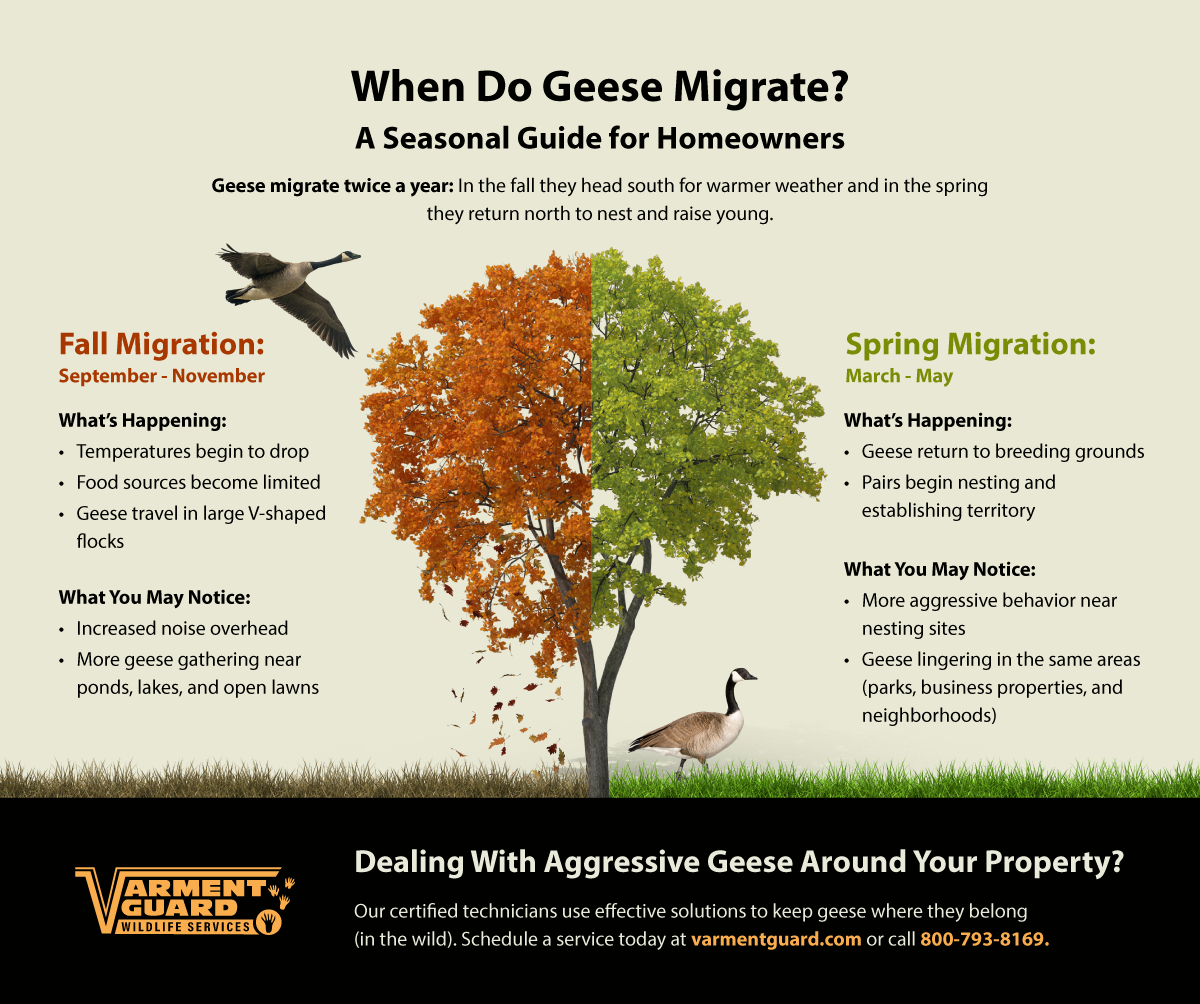
Canada geese migrate twice a year: south in September/October to states like Missouri, Illinois, Indiana, and Ohio, then north to Canada in March–May to breed. They navigate using the Earth's magnetic field, the sun, and familiar landmarks. Not all populations migrate; some stay in urban areas year-round with accessible food and water.
If you have a large goose population around your property, it’s probably the Canada goose. The Canada goose is the most common goose in North America. These birds don’t always migrate, but when they do, they fly south from Canada in the fall so they can overwinter throughout the U.S. Then, in the spring and early summer, they fly back to Canada to breed and have goslings. When dealing with a goose problem, it's very difficult to find a resolution without the assistance of a professional animal removal company.
Understanding their behavior can prevent issues around your home. That’s why the experts at Varment Guard have compiled the what, the where, the when, and the how of geese migration.
The What: Canada Geese
The Canada goose is the largest and most widely known goose species in North America. These birds have a grey or brown crest, back, and wing feathers with a white or grey underbelly. Their bills, feet, neck, tail, and head are black.
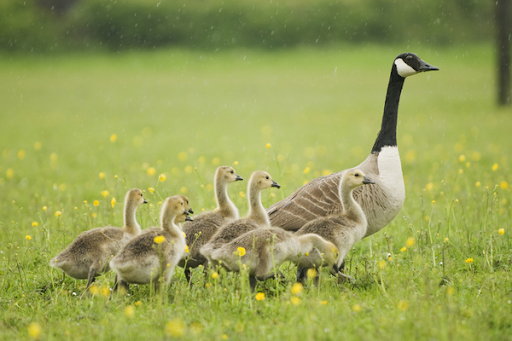
Canada goose with goslings
Why Do Geese Migrate?
Like most birds, Canada geese migrate north because it provides ideal conditions for raising their young:
- Northern regions offer abundant food sources like fresh grasses and aquatic plants
- There are longer daylight hours that give goslings more time to feed and grow
- These areas also tend to have fewer predators and less human disturbance, making them safer for nesting
As temperatures drop, geese fly south to avoid harsh winter conditions and limited food availability. However, not all Canada geese migrate. Some populations have adapted to urban and suburban environments where food and open water remain accessible year-round.
When Do Geese Migrate?
.png?r=ySEwXmesNaM=)
Canada geese that migrate do so twice a year. In September or October, Canada geese fly south to their non-breeding sites to avoid the cold. They’ll stay in their non-breeding sites all winter.
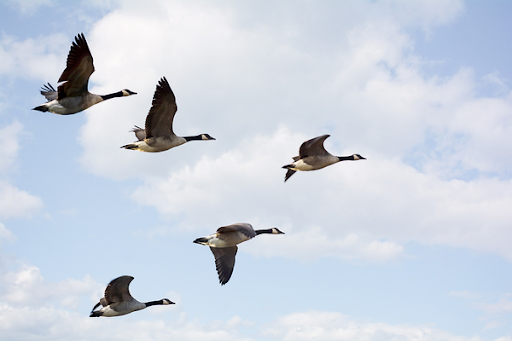
Geese migrate north to their breeding sites in March, April, or May. Migration flights usually begin at dusk, although you could see migrating geese flying in their distinctive “V” formation at any time of day.
Where Do Geese Migrate To?
Canada geese typically nest throughout Canada and sometimes as far as Alaska or the low Arctic to breed. For the winter, they migrate south to the central and southern United States. Common wintering areas include states like Missouri, Illinois, Indiana, Ohio, Kentucky, Tennessee, and parts of the Southeast such as Arkansas and Mississippi.
How Do Geese Know Where To Go?
Geese typically follow established routes, returning to the same breeding and non-breeding sites each year. In fact, migrating geese use various stop-off resting points as they travel—these remain largely the same as well. This means that the geese that you see every spring or fall are probably the same geese that were around your home the year before!
So, how do geese know where to go? Researchers have found that Canada geese rely on a combination of natural navigation tools, including the Earth’s magnetic field, the position of the sun, and familiar landmarks. Young geese also learn migration routes by traveling with experienced family groups.
While scientists continue to study the finer details of bird migration, it’s clear that geese use a mix of instinct and learned behavior to return to the same locations year after year.
How Geese Migration Affects Your Property
It’s important to be aware if geese are breeding and rearing goslings near you. Canada geese aren’t naturally aggressive but have no issue defending their young. If you encounter geese with their goslings, do not approach them or make any sudden movements. Geese tend to be more aggressive defending their nesting territory in the spring when their offspring are at their most defenseless.
Geese build nests near sources of water and will walk their goslings back and forth between the food, water, and the nest. Geese feed primarily on wetland grasses and weeds. During fall and winter, they’ll look for berries, seeds, and grains. Manicured grass is particularly easy for goslings to eat, which is why it’s not unusual for Canada geese to approach residential lawns.
You may also encounter geese if you live near bodies of water, especially in the spring and fall. Unless geese are worried about their goslings, they’re mostly uninterested or timid around people. As long as you leave them alone, Canada geese should leave you alone.
Are Canada Geese Causing You Trouble? Give us a Call.
Canada geese aren’t as horrible as their reputation may suggest. Mostly, they’re just trying to stay warm and protect their young. However, that doesn’t mean you want them hanging around your lawn.
If you’re playing host to a family of Canada geese, give Varment Guard a call. We can safely, humanely, and effectively remove Canada geese from your property and keep them from coming back.